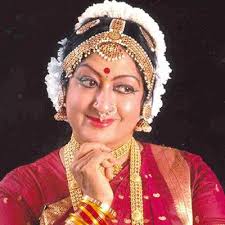
Bharatnatyam dance
Dr. Padma Subrahmanyam
Bharatanatyam Exponent • Scholar • Choreographer • Indologist
Dr. Padma Subrahmanyam was born on 4 February 1943 in Madras (now Chennai), Tamil Nadu, into a household steeped in art and culture. Her father, K. Subrahmanyam, was a pioneering figure in Indian cinema and a freedom fighter; her mother, Meenakshi Subrahmanyam, was a music composer, lyricist, and multi-instrumentalist. She began learning Bharatanatyam at Nrithyodaya Dance School, Chennai, founded by her father, and subsequently trained under the distinguished guru Vazhuvoor Ramaiah Pillai. She also trained in abhinaya under Gowri Ammal (Mylapore) and studied Carnatic music under B.V. Lakshmanan. She gave her first public performance (Arangetram) in 1956.
Dr. Subrahmanyam holds a Bachelor's Degree in Music, a Master's Degree in Ethnomusicology, and a Ph.D. from Annamalai University for her landmark thesis on Karanas in Indian Dance and Sculpture. Her doctoral research — undertaken with guidance from Dr. T.N. Ramachandran — demonstrated through correlative study of the Nāṭyaśāstra and temple sculptures of Tamil Nadu that the 108 Karanas described by Bharata Muni are dynamic movements rather than static poses. This work resulted in the reconstruction and revival of these techniques and gave rise to Bharata Nrithyam, a distinct repertoire she founded that draws directly from her research.
As a performer, choreographer, and composer, Dr. Subrahmanyam has presented her art at national and international festivals across Asia, Europe, Australia, Russia, and the Americas. She pioneered the inclusion of Pushpanjali as a formal dance piece, was the first dancer to adapt a Meera bhajan to the grammar of Pada Varnam, and composed the first Bengali Varnam with lyrics by Salil Chaudhury. She has composed music for the majority of her dance dramas, including works commissioned by the Government of Singapore. Documentaries on her life and art have been produced by Japan, Australia, and Russia.
A prolific scholar and author, she has written extensively on dance theory and aesthetics, with publications including Bharata's Art — Then and Now, Natya Sastra and National Unity, Kanchi Mahaswami's Vision of Asian Culture, and Bharatakkalai Kotpadu (Tamil). She is currently President of Nrithyodaya and the founder of the Bharatamuni Ilango Foundation for Asian Culture, located near Chennai.
Among her many distinctions, Dr. Subrahmanyam received the Sangeet Natak Akademi Award (1983), the Fukuoka Asian Cultural Prize (becoming the first dancer in the world to receive this honour), the Kalaimamani, the Kalidas Samman, and the Sangeet Natak Akademi Fellowship. She has served on the Academic Council of the Indira Gandhi National Centre for the Arts (IGNCA) and on multiple expert committees of the Ministry of Culture, Government of India. The Government of India has conferred upon her the Padma Shri (1981), the Padma Bhushan (2003), and the Padma Vibhushan (2024), among the nation's highest civilian honours.
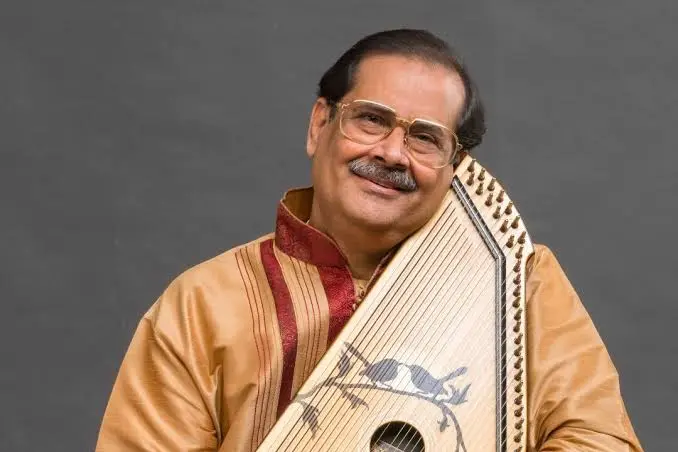
Indian classical vocal
Pandit Ajoy Chakrabarty
Hindustani Classical Vocalist • Patiala-Kasur Gharana • Composer • Educator
Pandit Ajoy Chakrabarty was born on 25 December 1952 in Kolkata, West Bengal. His parents noted that he could sing before he could talk. He received his initial training from his father, Ajit Chakrabarty, and went on to study under distinguished gurus including Pannalal Samanta, Kanaidas Bairagi, and Pandit Jnan Prakash Ghosh. He further deepened his training under Ustad Latafat Hussain Khan and Hirabai Barodekar, and broadened his musical horizons by studying Carnatic music under the renowned maestro M. Balamuralikrishna. He completed his B.A. and M.A. from Rabindra Bharati University, Kolkata.
In 1978, Pandit Chakrabarty became the first scholar of the ITC Sangeet Research Academy (ITC-SRA), where he subsequently became one of its youngest gurus — a position he continues to hold. He was the first recipient of the Kumar Gandharva Award, the most prestigious national recognition for the best musician of India under forty-five years of age. He also received the President's National Award for Best Male Playback Singer at the 37th National Film Awards (1990), the Sangeet Natak Akademi Award (1999–2000), and the National Tansen Samman (2015). The Government of West Bengal conferred upon him the Banga Bibhushan and the Maha Sangeet Samman in 2012.
An acclaimed exponent of the Patiala-Kasur gharana, Pandit Chakrabarty is celebrated for his mastery of khayal as well as lighter classical forms including thumri, tappa, bhajan, and kirtan. He has performed at some of the world's most prestigious venues, including Carnegie Hall and New Orleans Jazz Preservation Hall (USA), the Royal Albert Hall (UK), and Théâtre de la Ville (France). He was the first Indian classical vocalist to be invited by Pakistan and China, and by the BBC, for their respective Golden Jubilee Celebrations of India's Independence.
Pandit Chakrabarty is the founder of Shrutinandan, an Indian classical music academy dedicated to the preservation and transmission of the classical tradition. His daughter, Kaushiki Chakraborty, is herself a renowned Hindustani classical vocalist. The Government of India has conferred upon him the Padma Shri (2011) and the Padma Bhushan (2020) in recognition of his lifelong contribution to Indian classical music.